

🫁 Unit 11: Gas Exchange in Humans
Cambridge IGCSE Biology (0610)
🫁 Topic Area: Human Biology
⏱️ Estimated Reading Time: 20–25 minutes
🎯 Difficulty Level: ★★★☆☆
📖 Last Updated: September 2026
Understand how the human respiratory system is adapted for efficient gas exchange, the mechanics of breathing, and the effects of exercise and harmful substances on respiration.
🎯 Learning Objectives
By the end of this unit, you should be able to:
- 1. Explain why gas exchange is essential for human survival.
- 2. Identify and describe the structures of the human gas exchange system and explain their functions.
- 3. Explain how the alveoli are adapted for efficient gas exchange.
- 4. Describe the process of gas exchange between the alveoli and the blood.
- 5. Compare the composition of inspired and expired air.
- 6. Explain the mechanism of breathing (ventilation) during inspiration and expiration.
- 7. Describe the effects of exercise on breathing rate and depth.
📋 Syllabus Inclusion
Tick each point when you feel confident that you have learned it.
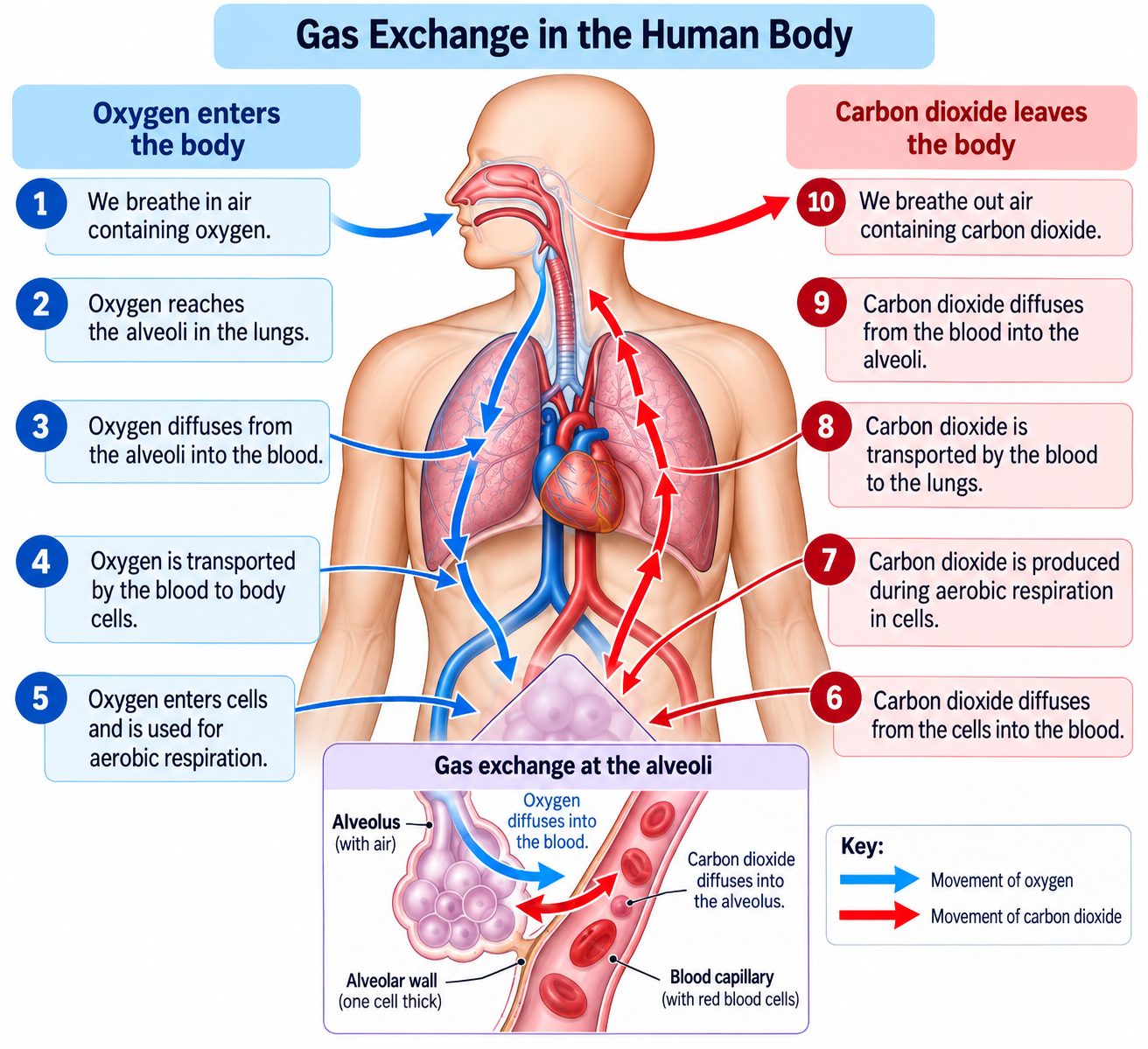
- Breathing is a physical process in which oxygen is taken in, and carbon dioxide is given out. We need to breathe because our cells are in need of continuous supply of oxygen for aerobic respiration. The energy release during the respiration is needed for almost every activity carried out by the cell.
- Small organisms such as single celled organisms can rely largely on diffusion, whereas we need a specialized gas exchange system because diffusion is sufficient for gas exchange across a short distance, but it is too slow to transport gases over long distances. Humans are large multicellular organisms, so most cells are deeply located and too far from the external environment (not in direct contact with the external environment).
- Oxygen is present in the air we breathe. When we breathe in, air enters the lungs. The oxygen in this air reaches the alveoli, where gas exchange takes place.
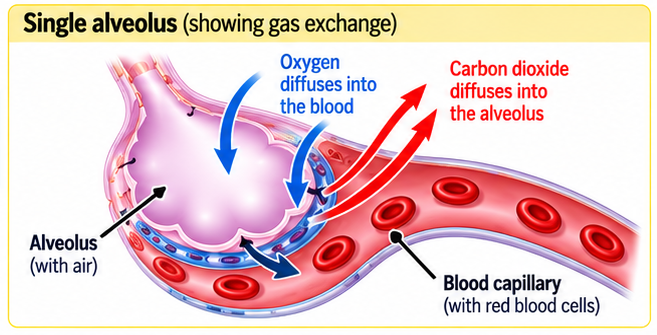
- At the alveoli, oxygen diffuses from the air in the alveoli into the blood
- The blood then transports oxygen around the body.
- Red blood cells contain hemoglobin, which combines with oxygen and transports it to the different parts of the body.
- At the tissues, oxygen diffuses from the blood into the cells.
- The oxygen is then used for the aerobic respiration in the cells to release energy.
- During respiration (aerobic), carbon dioxide is produced as by product which is then taken back by the blood to lungs
- The carbon dioxide is then diffused into the alveoli (in exchange of oxygen) and then breathed out.
Click image to enlarge
- Our cells are carrying out respiration continuously, even when we are asleep or inactive. Therefore, they continuously need oxygen to carry out respiration. At the same time, they also produce carbon dioxide which needs to be taken out.
- If breathing is stopped:
- The supply of oxygen to the blood would decrease
- Less oxygen would reach the cells
- Aerobic respiration would decrease
- Less energy would be available for cell activities
- Carbon dioxide would accumulate in the body
- During exercise, muscles need more energy because they are contracting more frequently and forcefully. Therefore, the rate of respiration increases. As a result, the body needs to take in more oxygen and remove more carbon dioxide. This explains why we breathe faster and deeper during exercise.
- Breathing and Respiration are not the same thing, which are generally mistakenly used together.
| Breathing | Respiration |
|---|---|
| Physical process | Chemical process |
| Moves air into and out of lungs | Releases energy from the glucose |
| Occurs in the respiratory system | Occurs in cells, mainly mitochondria |
| Includes breathing in and breathing out (inhalation and exhalation) | May be aerobic or anaerobic |
| Involves the use of muscles | Involves the use of enzyme |
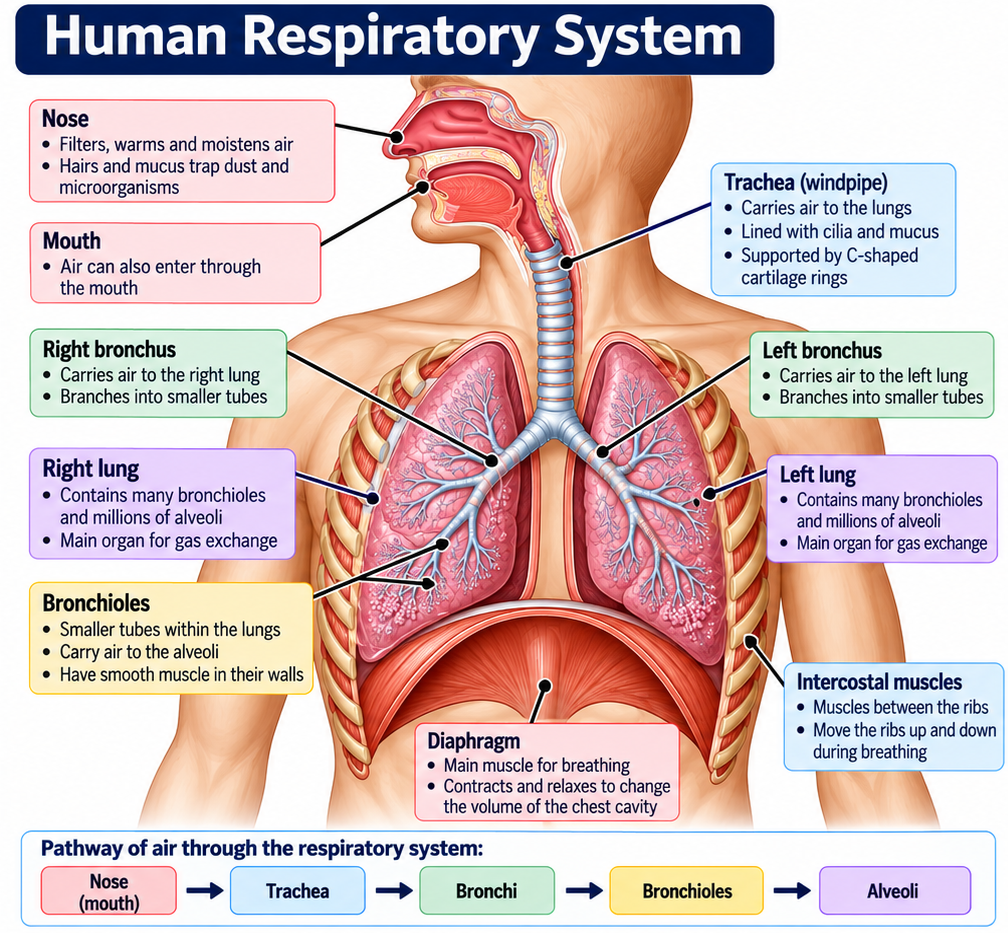
- The human gas exchange system is a group of organs and structures that allows the body to take in oxygen and remove carbon dioxide. Oxygen is needed by cells for the aerobic respiration. During this process, carbon dioxide is produced as a waste product and must be removed. The overall pathway of air is:
Nose/Mouth → Pharynx (throat) → Larynx (voice box) → Trachea (windpipe) → Bronchi → Lungs
Nose:
- Entry and exit point of air into and out of the body
- Filter air: Hairs and mucus trap dust, dirt and microorganisms
- Warm the air: The large blood supply in the lining of the nose warms incoming air
- Moisten the air: Mucus adds moisture to the air to help efficient diffusion
Larynx and Epiglottis:
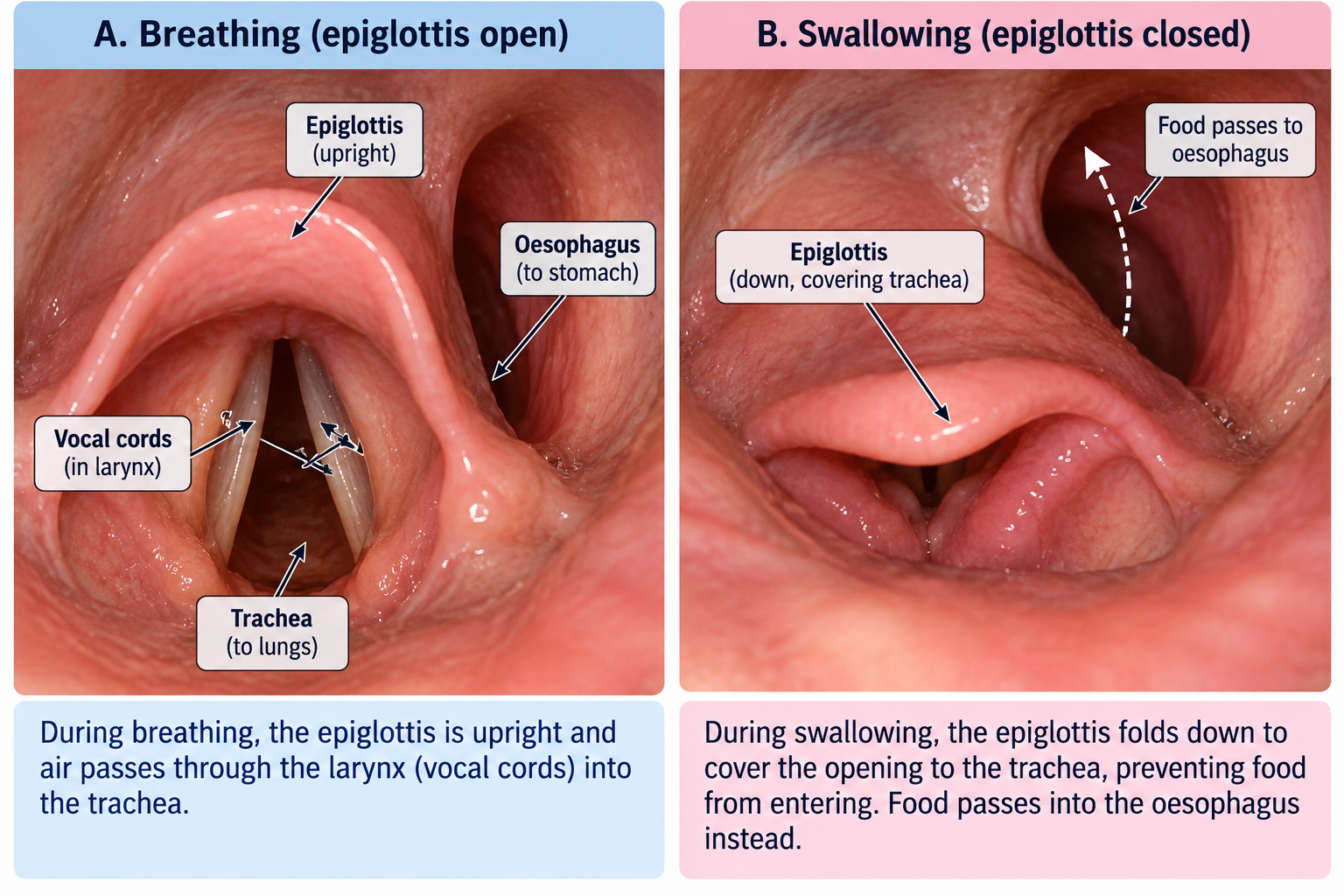
- Larynx contains vocal cords. Air passing over the vocal cords causes them to vibrate, producing sound
- The epiglottis is a flap-like structure which regulates the opening of trachea and esophagus.
- When food is swallowed, it closes the trachea and so food enters in the esophagus only.
Click image to enlarge
Click image to enlarge
Trachea:
- Also called as windpipe, relatively wide tube extending from larynx (voice box) to bronchi in the chest
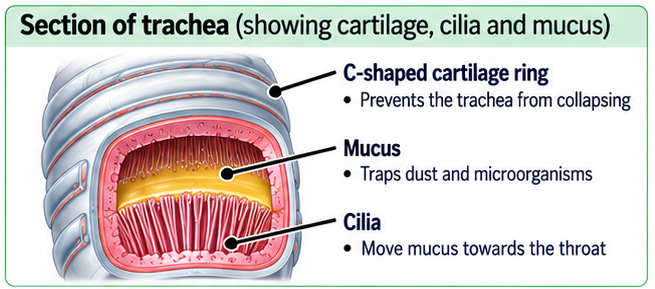
- It is supported by C-shaped rings of cartilage, which avoids collapsing of trachea when air pressure lowers (during breathing in mechanism)
- Lined with mucus producing goblet cells and ciliated epithelial cells.
- Its main function is to carry air to and from lungs. The mucus and cilia lining the trachea also help remove unwanted particles from the air.
Bronchi:
- Trachea divides into two main tubes called bronchi, which enter into each lung (left and right).
- Contain similar C-shaped cartilage and have lining of goblet cells and ciliated epithelial cells
- Carry air from trachea into each lung
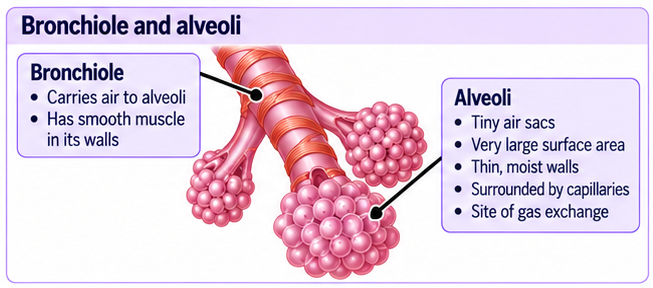
Bronchioles:
- Each bronchi (left and right) divides further into smaller tubes called bronchioles
- They have smooth muscles in their walls and have little or no cartilage compared with the bronchi
- Bronchioles distribute air throughout the lungs, carrying it towards the alveoli
Click image to enlarge
Click image to enlarge
Alveoli:
- They are the tiny air sacs (a bunch of grapes like structure) found at the end of bronchioles.
- They are the main site of gas exchange and highly adapted for the efficient gas exchange
- Large surface area: There are millions of alveoli, with a sac like structure providing a very large surface area. This allows more oxygen and carbon dioxide to diffuse at the same time
- Very thin walls: The wall of each alveolus is approximately one cell thick only. This decreases the distance for diffusion and increases the rate of diffusion.
- Good blood supply: Each alveolus is surrounded by a dense network of blood capillaries. The capillaries are also one cell thick walled. This allows oxygen to enter the blood rapidly and carbon dioxide to leave it.
- Maintained concentration gradients: Blood arriving at the alveoli contains relatively less oxygen and more carbon dioxide than air inside the alveoli. Also, as the blood is continuously flowing in the capillaries, it ensures that there is no equilibrium reach and diffusion is continuous
Inner lining of Airways:
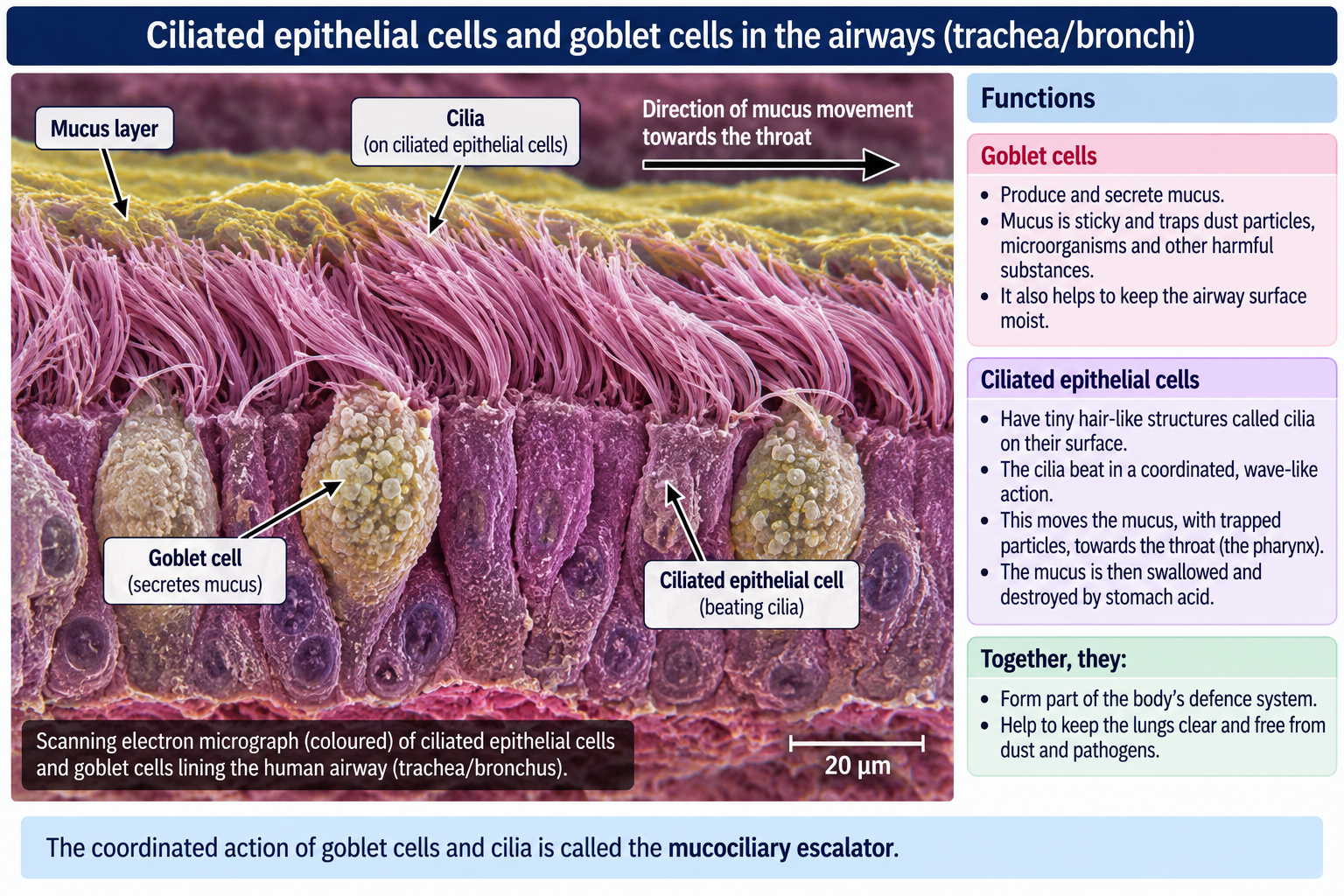
- Inner lining of airways specially up till the bronchioles are lined by specialised cells called goblet cells and ciliated epithelial cells from inside.
- Goblet cells secrete mucus, which makes a coating on the inner lining of airways. It is sticky and traps the dust particles and micro-organisms entering along with air.
- Ciliated epithelial cells have cilia on their surfaces which swaps the mucus upwards, towards the throat. The mucus is then swallowed and destroyed by stomach acid.
Click image to enlarge
Click image to enlarge
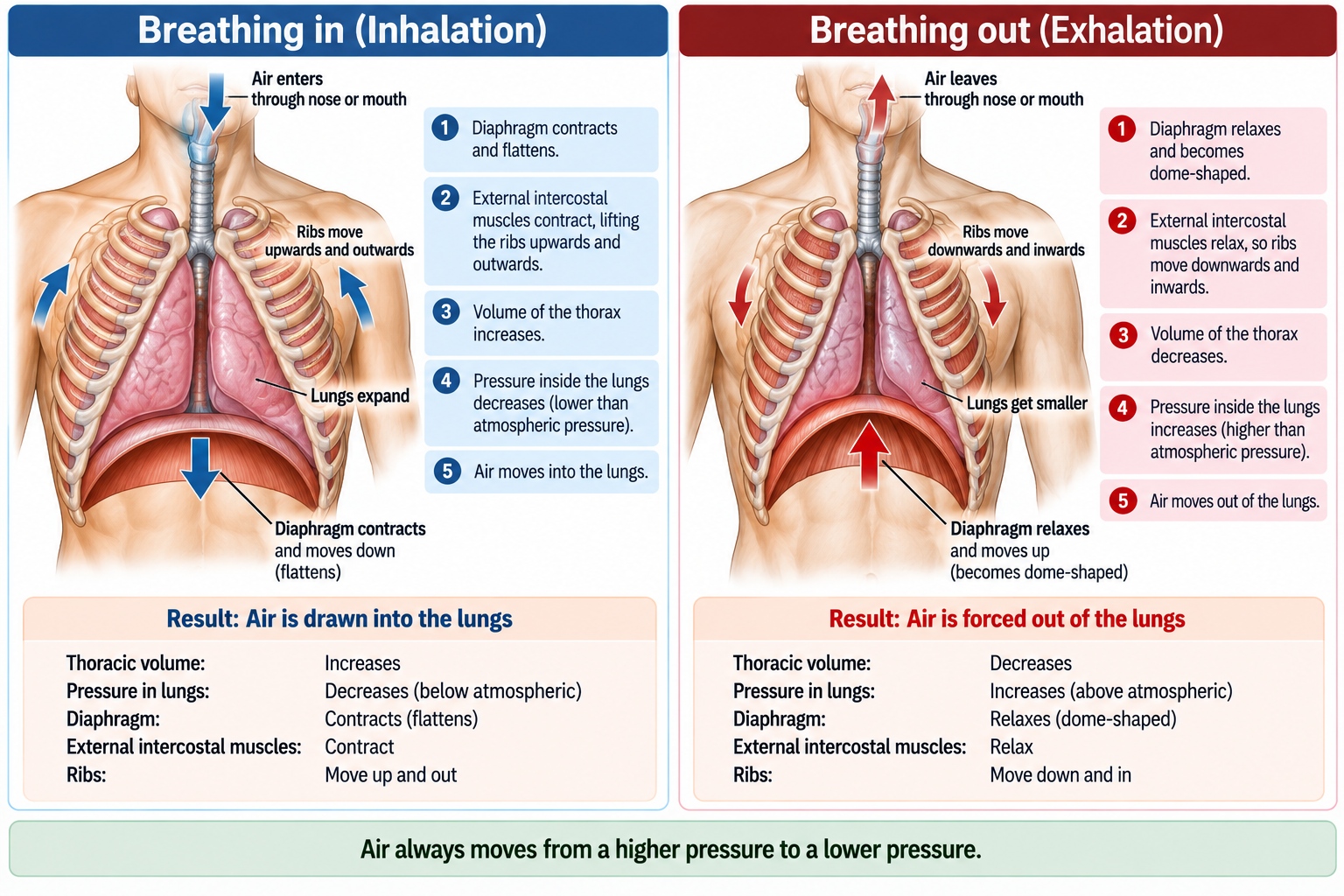
Mechanism of Breathing:
- It is a physical movement of air into and out of the lungs. It is regulated by muscles in the ribs (intercostal muscles) and diaphragm.
- There are two types of intercostal muscles: External intercostal muscles and Internal intercostal muscles. Both these muscles are antagonistic.
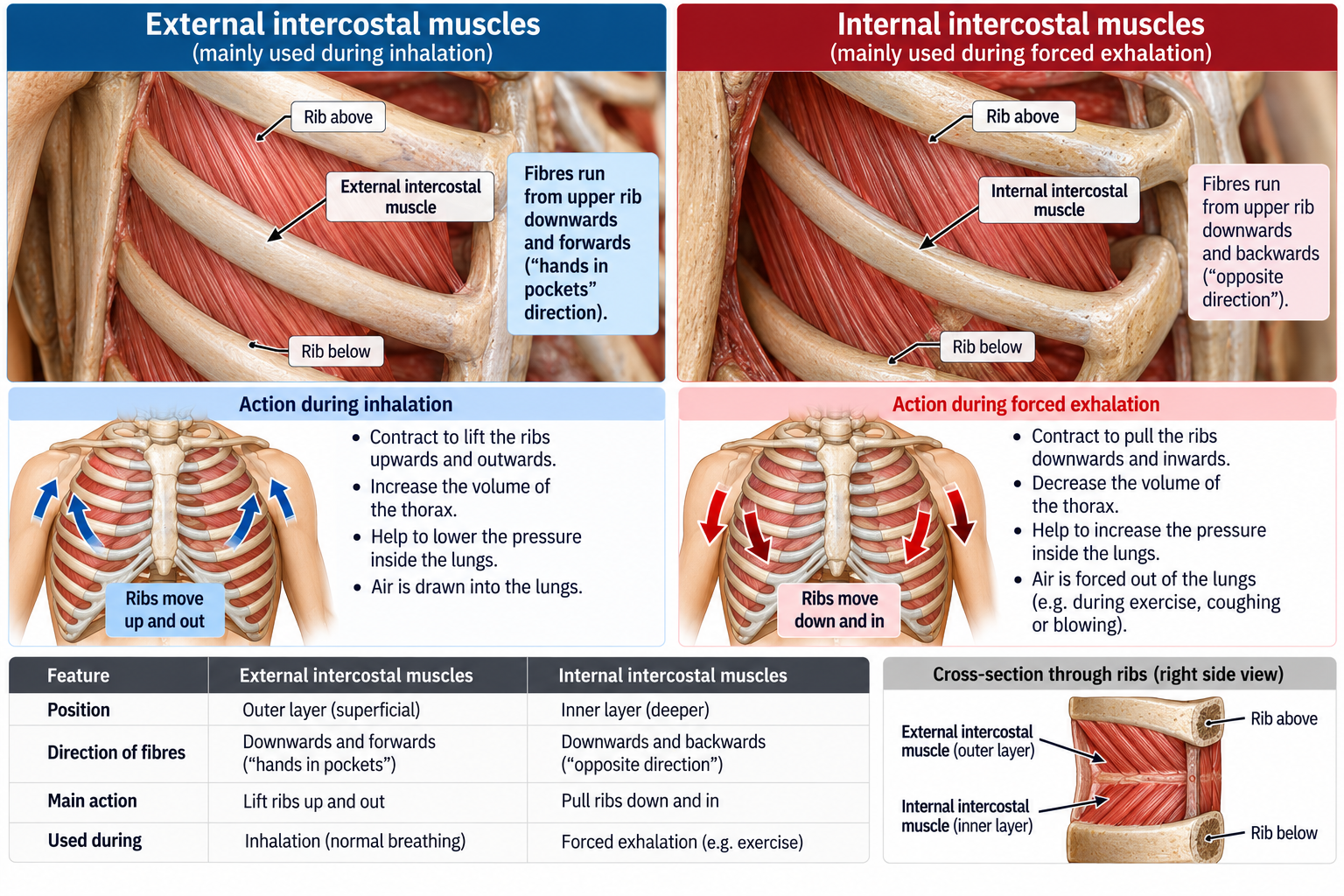
- The movement of air is produced by changes in the volume and pressure of the thorax (chest cavity).
- Two stages of breathing include: breathing in and breathing out.
| Breathing IN | Breathing OUT |
|---|---|
| Diaphragm contracts – Flattens and moves downwards | Diaphragm relaxes – Dome shaped and moves upwards |
| External intercostal muscles contract – Ribs moves upwards and outwards | External intercostal muscles relax – Ribs moves downwards and inwards |
| Volume of thorax increase – The chest cavity becomes larger, so volume expands | Volume of thorax decreases – The chest cavity becomes smaller, so volume decreases |
| Pressure inside the lungs decreases – As volume of thorax increases, the air pressure inside lungs decreases | Pressure inside the lungs increases – As volume of thorax decreases, the air pressure inside lungs increases |
| Air moves into the lungs – Air pressure outside is more, so air moves from outside to inside the lungs | Air moves out of the lungs – Air pressure inside is more, so air moves from inside to outside of the lungs |
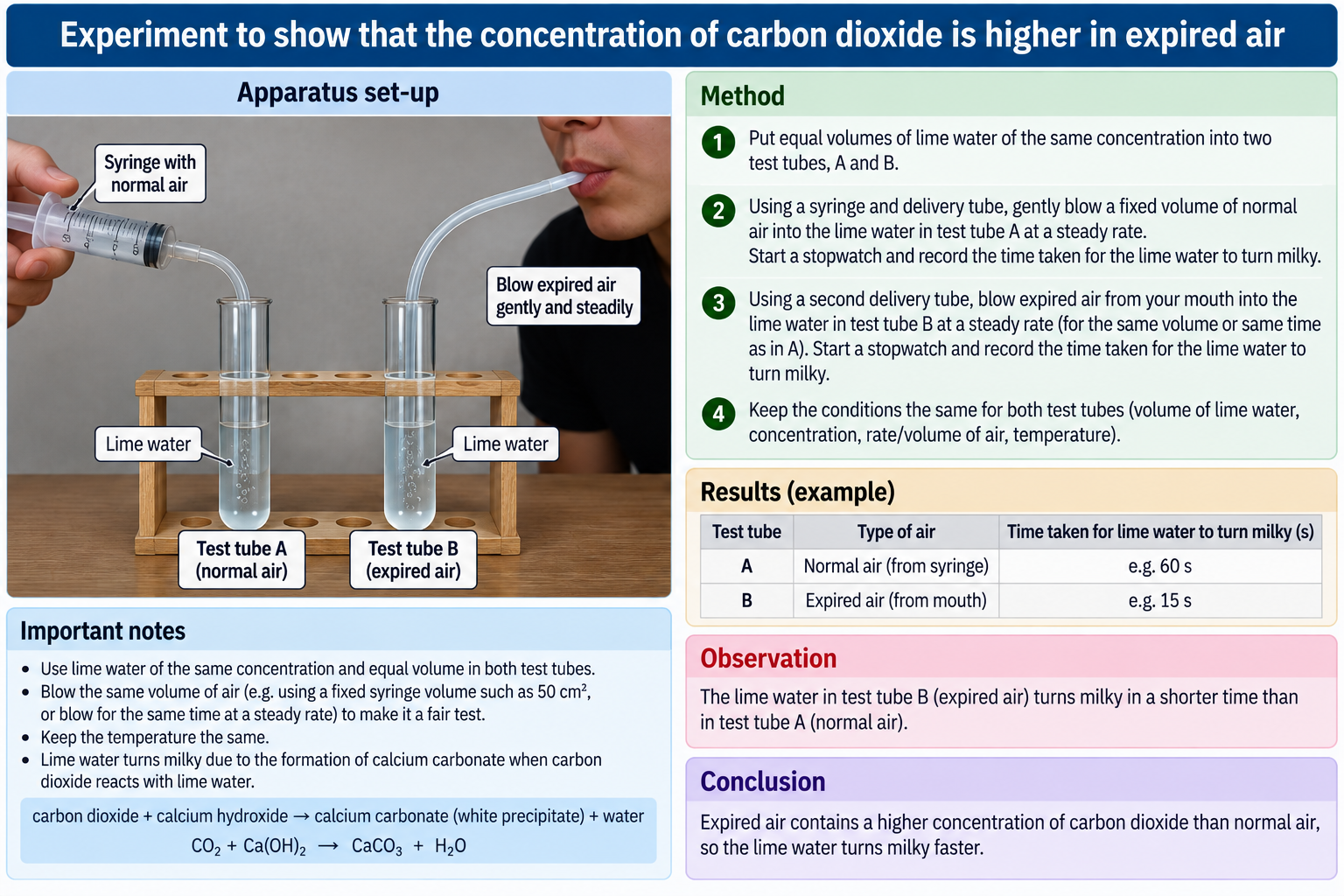
Composition of inspired and expired air
The air we breathe in is called inspired air, while the air we breathe out is called expired air.
Their composition is different because gas exchange occurs in the alveoli.
| Gas | Inspired air | Expired air | Change |
| Oxygen | ~21% | ~16% | Decreases |
| Carbon dioxide | ~0.04% | ~4% | Increases |
| Nitrogen | ~78% | ~78% | Little/no change |
| Water vapour | Variable | Higher | Increases |
The exact percentages may vary slightly depending on the source and conditions.
- Expired air contains less oxygen and more carbon dioxide than inspired air because oxygen diffuses into the blood for aerobic respiration, while carbon dioxide produced by respiration diffuses from the blood into the alveoli.
- Nitrogen remains approximately unchanged because it is not significantly involved in respiration or gas exchange.
- Expired air also contains more water vapour because the respiratory surfaces are moist.
Effect of Exercise on Breathing
During exercise, muscles work harder and require more energy. Therefore, the rate of aerobic respiration increases.
Exercise → respiration increases → oxygen demand increases + more CO₂ produced
The body responds by:
- Breathing rate increases – more breaths are taken per minute.
- Breathing depth increases – more air is taken in with each breath.
- This brings more oxygen into the lungs and removes the increased carbon dioxide produced by the muscles.
After exercise
Breathing remains faster and deeper for a short time to help the body recover. Gradually, the breathing rate and depth return to normal.
Exercise → respiration ↑ → O₂ demand ↑ + CO₂ production ↑ → breathing rate ↑ + breathing depth ↑ → recovery → breathing returns to normal.
Summary
| During exercise | Why? |
| Rate of respiration increases | Muscles need more energy |
| Oxygen demand increases | More oxygen is required for aerobic respiration |
| CO₂ production increases | More aerobic respiration occurs |
| Breathing rate increases | More air must enter and leave the lungs |
| Breathing depth increases | A greater volume of air is moved per breath |
| More oxygen enters the blood | Increased demand from muscles |
| More CO₂ is removed | Increased production by muscles |
You have learned how breathing, gas exchange and respiration are connected. Now test whether you can explain the “why” and “how”, not just remember the facts.
Try to answer each question in your own words before revealing the explanation.
1. Why can’t humans rely on diffusion alone to obtain oxygen?
Humans are large multicellular organisms, so many cells are far from the external environment. Diffusion over such long distances would be too slow to supply the oxygen at the rate required by cells. Therefore, humans need a specialised gas exchange system and a circulatory system to bring oxygen close to cells and transport it rapidly around the body.
Humans are large multicellular organisms, so many cells are far from the external environment. Diffusion over such long distances would be too slow to supply the oxygen at the rate required by cells. Therefore, humans need a specialised gas exchange system and a circulatory system to bring oxygen close to cells and transport it rapidly around the body.
2. Why do we need to breathe if respiration happens inside our cells?
Breathing brings air containing oxygen into the lungs and removes carbon dioxide. Oxygen then diffuses from the alveoli into the blood and is transported to cells, where it is used for aerobic respiration. Carbon dioxide produced by respiration is transported back to the lungs and breathed out.
Breathing → gas exchange → oxygen reaches cells → aerobic respiration
3. Why are alveoli well adapted for gas exchange?
Alveoli provide a large surface area, have very thin walls, are moist, and are surrounded by a good supply of blood capillaries. These features offer a short diffusion distance and maintain concentration gradients, allowing oxygen and carbon dioxide to diffuse rapidly.
Alveoli provide a large surface area, have very thin walls, are moist, and are surrounded by a good supply of blood capillaries. These features offer a short diffusion distance and maintain concentration gradients, allowing oxygen and carbon dioxide to diffuse rapidly.
4. Why is expired air different from inspired air?
Oxygen in the inspired air diffuses into the blood and is used by cells for aerobic respiration. Carbon dioxide produced during respiration diffuses from the blood into the alveoli and is breathed out. Therefore, expired air contains less oxygen and more carbon dioxide than inspired air. It also contains more water vapour because the respiratory surfaces are moist.
Oxygen in the inspired air diffuses into the blood and is used by cells for aerobic respiration. Carbon dioxide produced during respiration diffuses from the blood into the alveoli and is breathed out. Therefore, expired air contains less oxygen and more carbon dioxide than inspired air. It also contains more water vapour because the respiratory surfaces are moist.
5. Why does breathing become faster and deeper during exercise?
During exercise, muscles work harder and require more energy. Therefore, the rate of respiration increases, creating a greater demand for oxygen and producing more carbon dioxide. Breathing becomes faster and deeper to bring more oxygen into the lungs and remove the additional carbon dioxide.
Exercise → respiration ↑ → O₂ demand ↑ + CO₂ production ↑ → breathing rate and depth ↑
6. Why does normal breathing out not require contraction of the internal intercostal muscles?
During normal breathing out, the diaphragm and external intercostal muscles relax. The lungs and chest wall recoil naturally, causing the volume of the thorax to decrease and pressure inside the lungs to increase. Air therefore moves out. The internal intercostal muscles become important during forced exhalation, when they contract to pull the ribs downwards and inwards.
During normal breathing out, the diaphragm and external intercostal muscles relax. The lungs and chest wall recoil naturally, causing the volume of the thorax to decrease and pressure inside the lungs to increase. Air therefore moves out. The internal intercostal muscles become important during forced exhalation, when they contract to pull the ribs downwards and inwards.