A-Level Biology (9700) Resources:

Past Papers
Practice with exam-style past papers to strengthen topic understanding and improve question-solving confidence.
Worksheets
Reinforce key biology concepts with structured worksheets designed for focused practice and revision.
Study Material
Access clear, concise notes and learning resources aligned with the A-Level Biology syllabus.
Candidates for Cambridge International A-Level Biology study the following topics:
Unit-12: Energy and respiration
- 12.1 Energy
- 12.2 Respiration
Unit-13: Photosynthesis
- 13.1 Photosynthesis as an energy transfer process
- 13.2 Investigation of limiting factors
Unit-14: Homeostasis
- 14.1 Homeostasis in mammals
- 14.2 Homeostasis in plants
Unit-15: Control and coordination
- 15.1 Control and coordination in mammals
- 15.2 Control and coordination in plants
Unit-16: Inheritance
- 16.1 Passage of information from parents to offspring
- 16.2 The roles of genes in determining the phenotype
- 16.3 Gene control
Unit-17: Selection and variation
- 17.1 Variation
- 17.2 Natural and artificial selection
- 17.3 Evolution
Unit-18: Classification, biodiversity and conservation
- 18.1 Classification
- 18.2 Biodiversity
- 18.3 Conservation
Unit-19: Genetic technology
- 19.1 Principles of genetic technology
- 19.2 Genetic technology applied to medicine
- 19.3 Genetically modified organisms in agriculture
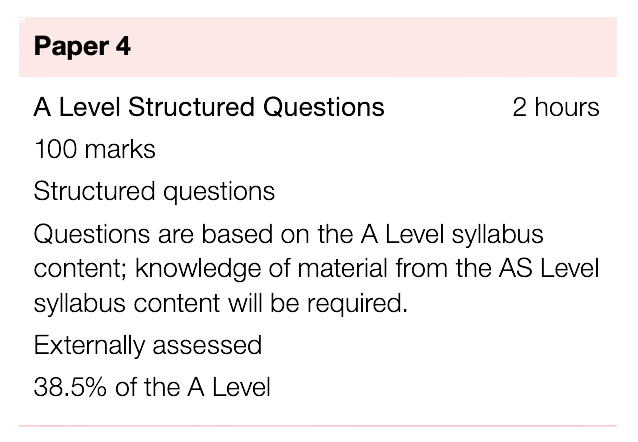
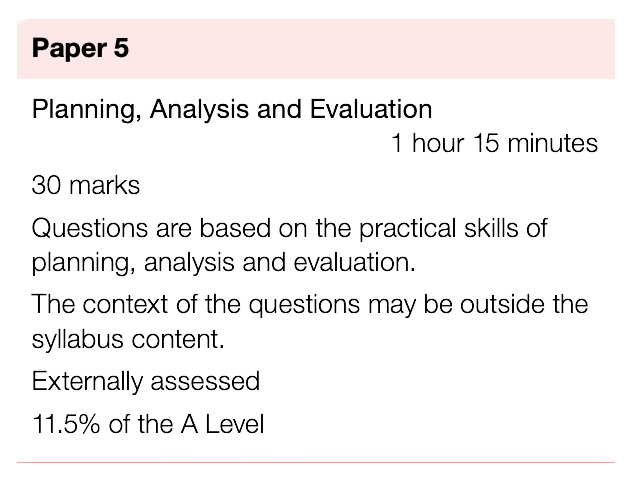
Details of the assessment:
Candidates for Cambridge International A Level should study all topics mentioned above, i.e. from 12 to 19, as well as topics mentioned in Cambridge International AS Level i.e. from 1 to 11.
The content of the Cambridge International AS Level learning outcomes are assumed knowledge for the Cambridge International A Level components.
Candidates can carry forward their Cambridge International AS Level results subject to the rules and time limits described in the Cambridge Handbook.
Candidates taking up Cambridge International A Level, followed by Cambridge International AS Level, are eligible for grades A* – E.
For more details, please check: https://www.cambridgeinternational.org/programmes-and-qualifications/cambridge-international-as-and-a-level-biology-9700/