IGCSE Biology (0610) Resources:

Past Papers
Practice with exam-style past papers to strengthen topic understanding and improve question-solving confidence.
Worksheets
Reinforce key biology concepts with structured worksheets designed for focused practice and revision.
Study Notes
Access clear, concise notes and learning resources aligned with the IGCSE Biology syllabus.
Unit-1: Characteristics and classification of living organisms
- 1.1 Characteristics of living organisms
- 1.2 Concepts and uses of classification systems
- 1.3 Features of organisms
Unit-2: Organisation of the organisms
- 2.1 Cell structure
- 2.2. Size of the specimen
Unit-3: Movement into and out of cells
- 3.1 Diffusion
- 3.2 Osmosis
- 3.3 Active transport
Unit-4: Biological molecules
- 4.1 Biological molecules
- 4.2 State that large molecules are made from smaller molecules
- 4.3 Describe the estimation of biomolecules with simple lab test
- 4.4 Describe the structure of a DNA molecules
Unit-5: Enzymes
- 5.1 Enzymes
- 5.2 Mechanism of enzyme action
- 5.3 Factors affecting the rate of enzyme action
Unit-6: Plant nutrition
- 6.1 Photosynthesis
- 6.2 Investigate the requirements for photosynthesis
- 6.3 Leaf structure
Unit-7: Human nutrition
- 7.1 Diet
- 7.2 Digestive system
- 7.3 Physical digestion
- 7.4 Chemical digestion
- 7.5 Absorption
Unit-8: Transport in plants
- 8.1 Xylem and phloem
- 8.2 Water uptake
- 8.3 Transpiration
- 8.4 Translocation
Unit-9: Transport in humans
- 9.1 Circulatory system
- 9.2 Heart
- 9.3 Blood vessels
- 9.4 Blood
Unit-10: Diseases and immunity
- 10.1 Diseases, pathogen and body defences
- 10.2 Immunity
Unit-11: Gas exchange in humans
- 11.1 Human respiratory system
- 11.2 Mechanism of breathing
Unit-12: Respiration
- 12.1 Respiration
- 12.2 Aerobic respiration
- 12.3 Anaerobic respiration
Unit-13: Excretion in humans
- 13.1 Human excretory system
- 13.2 Mechanism of formation of urine
Unit-14: Coordination and response
- 14.1 Coordination and response
- 14.2 Sense organs
- 14.3 Hormones
- 14.4 Homeostasis
- 14.5 Coordination in plants – Tropic responses
Unit-15: Drugs
- 15.1 Drugs
- 15.2 Antibiotics resistance and MRSA
Unit-16: Reproduction
- 16.1 Asexual reproduction
- 16.2 Sexual reproduction
- 16.3 Sexual reproduction in plants
- 16.4 Sexual reproduction in humans
- 16.5 Sex hormones in humans
- 16.6 Sexually transmitted infections
Unit-17: Inheritance
- 17.1 Chromosomes, genes and proteins
- 17.2 Mitosis
- 17.3 Meiosis
- 17.4 Monohybrid inheritance
- 17.5 Codominance and ABO blood grouping
Unit-18: Variation and selection
- 18.1 Variation
- 18.2 Adaptive features
- 18.3 Selection
Unit-19: Organisms and their environment
- 19.1 Energy flow
- 19.2 Food chain and food web
- 19.3 Nutrient cycles
- 19.4 Population studies
Unit-20: Human influences on ecosystem
- 20.1 Food supply
- 20.2 Habitat destruction
- 20.3 Pollution
- 20.4 Conservation
Unit-21: Biotechnology and genetic modification
- 21.1 Biotechnology and genetic modification
- 21.2 Biotechnology
- 21.3 Genetic modification
Details of the assessment:
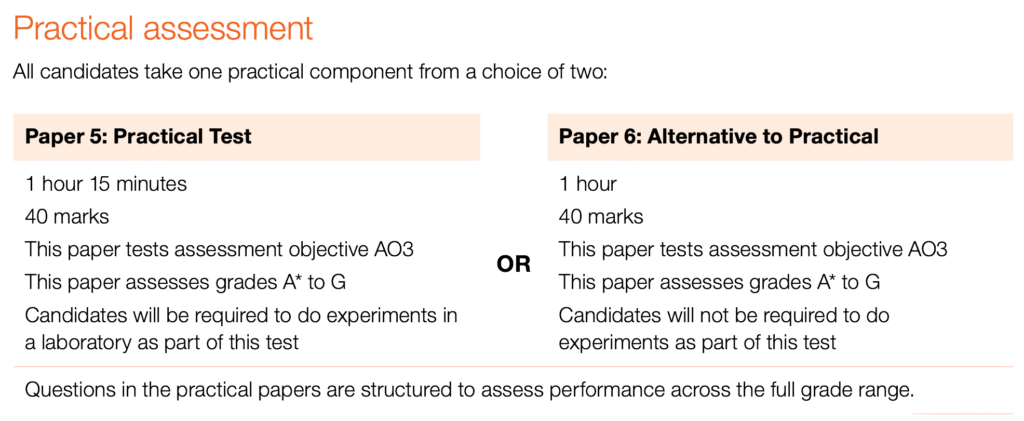
All candidates take three papers.
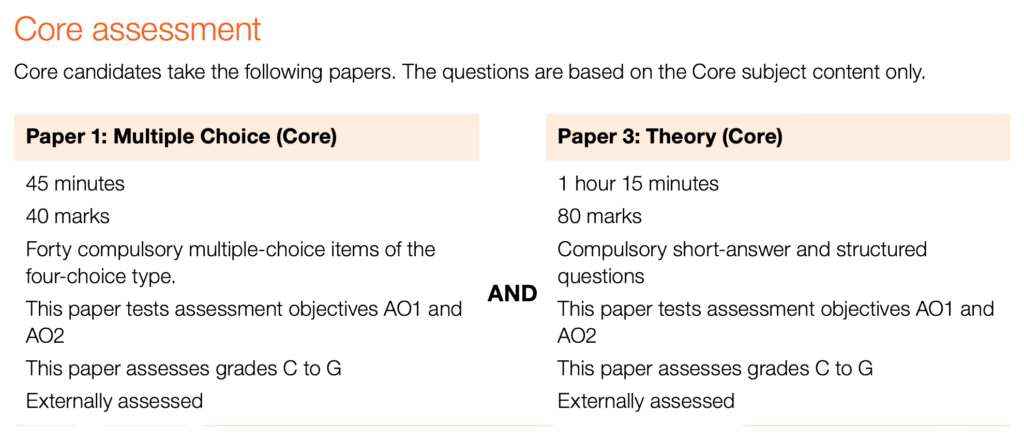
Candidates who have studied the Core subject content, or who are expected to achieve a grade D or below should be entered for Paper 1, Paper 3 and either Paper 5 or Paper 6. These candidates will be eligible for grades C to G.
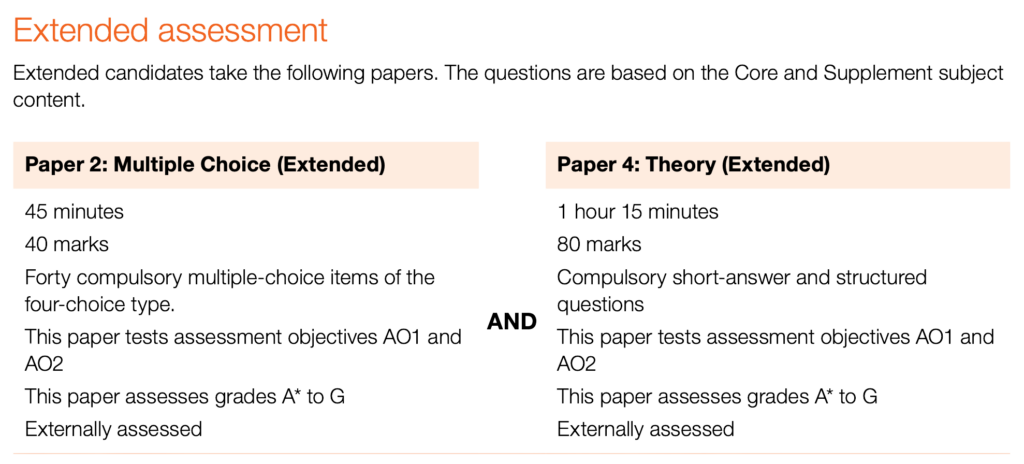
Candidates who have studied the Extended subject content (Core and Supplement), and who are expected to achieve a grade C or above should be entered for Paper 2, Paper 4 and either Paper 5 or Paper 6. These candidates will be eligible for grades A* to G.
For more details, please check: https://www.cambridgeinternational.org/programmes-and-qualifications/cambridge-igcse-biology-0610